
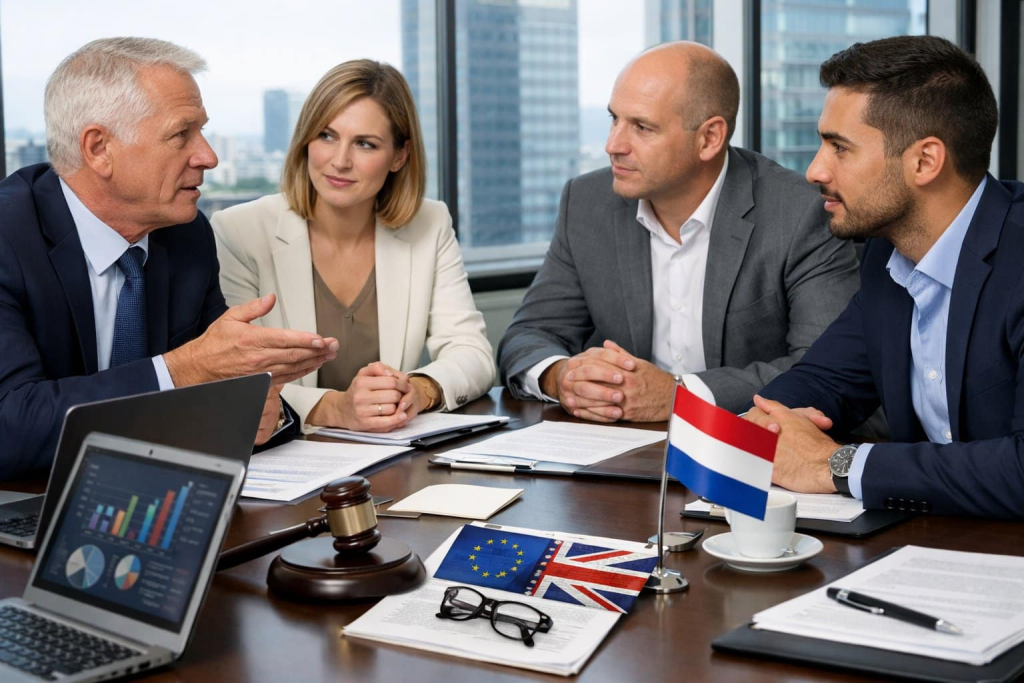
Why VAT Leakage Became a Major Issue for UK Entrepreneurs After Brexit
For many UK entrepreneurs, the postBrexit landscape has introduced a new layer of complexity when trading with the European Union. VAT rules have shifted, administrative burdens have increased, and the loss of automatic access to the single market has created friction that did not exist before 2021. As a result, a growing number of British founders are turning to the Netherlands as a strategic base to reenter the EU market efficiently.
Establishing a Dutch company supported by a virtual business address in Amsterdam has become one of the most effective ways to reduce VAT leakage, streamline compliance, and restore operational freedom across Europe. This approach offers a blend of legal clarity, tax efficiency, and logistical simplicity, making it an increasingly popular model for UK businesses seeking to scale within the EU.
Why the Netherlands Is the Ideal EU Gateway for UK Businesses
The Netherlands has emerged as a preferred gateway for several reasons. It offers a transparent and businessfriendly regulatory environment, a highly international commercial culture, and one of the most straightforward company formation processes in Europe. Incorporating a Dutch BV is fast and familiar for UK entrepreneurs because the structure resembles a private limited company. English is widely used in both business and government, reducing friction and accelerating communication.
Most importantly, a Dutch company regains direct access to the EU single market, enabling smoother trade, simplified VAT registration, and more predictable compliance obligations. This is particularly valuable for UK entrepreneurs who lost these advantages after Brexit and now face thirdcountry treatment when dealing with EU clients and suppliers.
The Strategic Role of a Virtual Business Address in Amsterdam
A virtual business address in Amsterdam plays a central role in this strategy. Dutch authorities require a verifiable local address to register a company with the Chamber of Commerce (KvK), and a professional address provider ensures that this requirement is met without the need for a physical office. A recognised Amsterdam address enhances credibility with clients, partners, and banks, while also ensuring that official correspondence from Dutch authorities is handled securely and promptly.
For UK entrepreneurs, this address is more than a formality: it establishes a legitimate EU presence, supports VAT registration, and provides the administrative foundation needed to operate compliantly within the European market.
How a Dutch Company Helps Prevent VAT Leakage on EU–UK Trade
Avoiding VAT leakage begins with understanding how VAT rules apply when trading between the UK and the EU. Since Brexit, the UK is treated as a third country, meaning that different VAT rules apply compared to intraEU trade. When a Dutch company sells products to the UK, it can apply 0% VAT on exports, provided it can prove that the goods have left the EU.
This requires proper documentation such as a consignment agreement or export declaration. The Dutch business must still report the export turnover in its VAT return under the relevant section, but no Dutch VAT is due on the transaction. This structure prevents unnecessary VAT charges and ensures that VAT is only applied where legally required.
Using the Dutch Article 23 Permit to Avoid Upfront Import VAT
For UK entrepreneurs importing goods into the Netherlands through their Dutch company, VAT is charged by Dutch customs on the value of the goods. However, the Netherlands offers a powerful mechanism to avoid upfront VAT payments: the Article 23 permit.
With this permit, VAT on imports is deferred and declared in the periodic VAT return instead of being paid at the border. This significantly improves cash flow and reduces administrative burdens, making the Netherlands one of the most efficient entry points for goods destined for the EU market.
Preventing VAT Leakage on Services Through Correct PlaceofSupply Rules
VAT leakage also occurs when services are incorrectly invoiced or when businesses misunderstand the placeofsupply rules. For B2B services, the general rule is that VAT is due where the customer is established. This means that if a UK entrepreneur provides services to EU business clients, the services are typically outside the scope of UK VAT, and the EU customer accounts for VAT under the reverse charge mechanism.
No UK VAT is added to the invoice, and the EU client selfassesses the VAT in their own country. Proper documentation, including the customer’s EU VAT number, is essential to maintain this treatment and avoid reclassification that could trigger unexpected VAT liabilities.
Similarly, when EU businesses provide services to UK companies, the UK recipient must account for VAT under the reverse charge. This mechanism prevents double taxation and ensures that VAT is correctly allocated to the jurisdiction where the service is consumed. Understanding these rules is crucial for UK entrepreneurs operating through a Dutch company, as misapplying them can lead to VAT leakage, compliance failures, or unnecessary registrations.
READ MORE : https://vatonlinecalculator.co.uk/
Centralising EU VAT Compliance Through a Dutch BV
A Dutch company with a virtual address also simplifies VAT registration within the EU. Many UK entrepreneurs struggle with VAT obligations when selling goods or digital services to EU consumers, especially under the OneStop Shop (OSS) scheme.
By operating through a Dutch entity, VAT registration becomes more straightforward, and the business can centralise its EU VAT obligations in one jurisdiction. This reduces administrative complexity and ensures that VAT is correctly collected, reported, and remitted, preventing leakage caused by fragmented or inconsistent compliance across multiple EU countries.
A Dutch BV as a LongTerm Solution for EU Market Access
The combination of a Dutch BV and a virtual office in Amsterdam provides a stable, compliant, and efficient structure for UK entrepreneurs seeking to rebuild their EU presence. It restores access to the single market, reduces VAT exposure, and offers a professional foundation for longterm growth.
With the right setup, UK businesses can operate leaner, faster, and more competitively across Europe, turning postBrexit challenges into strategic advantages.