
For facility managers, landscape contractors, and logistics operators, managing bulky, irregular materials like brush, demolition debris, scrap metal, and logs is a daily challenge. While standard buckets are effective for loose, granular materials, they fall short when handling items that are large, tangled, or need to be sorted. A dedicated grapple attachment transforms a compact mini skid steer into a highly efficient material handling machine, enabling operators to tackle a wider range of tasks with speed and precision. This article explores the technology, applications, and safety considerations of skeleton grapple attachments for compact loaders.
The Strategic Role of Specialized Grapple Attachments in Material Handling
In industrial and commercial settings, the ability to quickly and safely handle mixed materials directly impacts project timelines and labor costs. Tasks such as clearing overgrown land, sorting recyclables at a transfer station, or cleaning up after a demolition all require secure grasping and maneuvering of unwieldy items. A skeleton grapple combines a robust clamping mechanism with an open, tined base, allowing operators to firmly grip and transport materials while simultaneously sifting out fine debris. This consolidation of functions enhances on-site efficiency and reduces the need for manual sorting or multiple machine passes.
Technical Overview and Core Functionality
Design and Operation of a Mini Skid Steer Skeleton Grapple
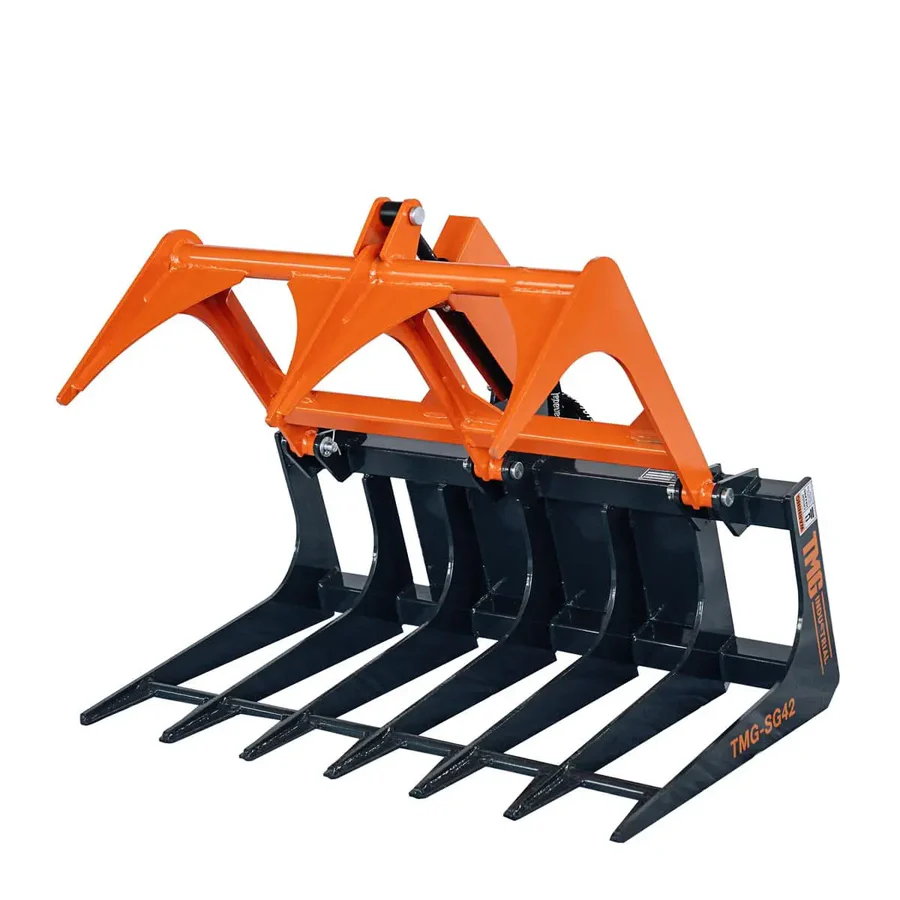
A skeleton grapple attachment is hydraulically powered, connecting directly to the auxiliary hydraulics of the mini skid steer. Its primary components include a fixed lower jaw, often constructed from spaced steel tines (forming the ‘skeleton’), and a hydraulically actuated upper jaw or arm that closes to clamp materials against the lower tines. The open tine design allows dirt, small rocks, and other fine debris to fall through during pickup, resulting in cleaner loads and reduced material handling. A unit like the 42″ Mini Skid Steer Skeleton Grapple Attachment is specifically engineered for compact loaders. It features a single, powerful hydraulic cylinder housed within a protective guard, capable of exerting up to 2000 pounds of grappling force. The 24-inch arm opening provides ample capacity for grasping mixed materials, from individual logs to piles of brush or scrap.
Key Specifications and Compatibility Features
- Mounting System: This model utilizes a Toro-style mount, designed for quick and secure attachment to mini skid steers from Toro and other brands using this common interface. This ensures a wobble-free connection and fast attachment changes.
- Working Dimensions: With a 42-inch working width and 6.5-inch tine spacing, it offers a productive capacity suitable for compact machines while effectively sifting common debris.
- Hydraulic Specifications: The grapple operates at a hydraulic pressure of 3000 PSI. It comes complete with hydraulic hoses and flat-face couplers, simplifying connection to the machine’s hydraulic system and promoting leak-free operation.
- Durability Features: The hydraulic cylinder is shielded by a protective guard to prevent damage from falling debris. Greaseable pins and bushings are incorporated at pivot points, facilitating regular maintenance and extending service life.
The Critical Importance of Efficiency, Safety, and Productivity
The efficiency gain from using a dedicated grapple is substantial. Tasks that might require manual handling, chains, or multiple machine functions can be completed in a single operation. For instance, clearing a felled tree involves grabbing, lifting, and transporting the entire load, rather than cutting, dragging, and piling it. This directly boosts operator productivity. Safety is significantly enhanced by keeping the operator in the cab, away from falling or rolling debris, and eliminating the need for ground personnel to handle hazardous materials like sharp scrap metal or tangled brush. The secure grip of the grapple prevents materials from shifting or falling during transport, reducing risk.
Technical Foundations and Capability Considerations
Hydraulic Power and Mechanical Advantage
The 2000-pound grappling capacity is a function of the hydraulic cylinder’s force and the mechanical linkage of the arm. The system is designed to provide strong clamping force while maintaining a wide opening range. The protective guard over the cylinder is a critical design feature, as the cylinder rod is vulnerable to impact damage from falling rocks or logs. The inclusion of flat-face couplers is also notable; they are less prone to dirt ingress and pressure loss compared to older coupling styles, ensuring reliable hydraulic connection.
Structural Integrity and Material Sifting
The lower skeleton tines are built from high-strength steel to resist bending under heavy loads. The 6.5-inch spacing is optimized for the compact loader class, allowing most soil and small debris to fall through while retaining larger material like rocks, stumps, and scrap. The 23-inch tine length provides a stable base for holding materials securely during transport.
Factors Influencing Performance, Safety, and Effectiveness
Several variables affect how well a grapple performs. The mini skid steer’s hydraulic flow and pressure must be compatible with the grapple’s requirements to ensure adequate arm speed and clamping force. Operator technique is key; learning to position the machine and use the grapple’s curl function to scoop and secure loads maximizes efficiency. Material type and density influence the approach; loose brush may be gathered differently than heavy, compact scrap. Regular maintenance, including greasing pivot pins and inspecting hoses and the cylinder rod for damage, is essential for reliable, safe operation.
Safety Considerations and Industry Best Practices
Operating a hydraulically powered grapple with a 2000-pound capacity requires a disciplined focus on safety to protect the operator, ground personnel, and equipment.
Essential Safety Protocols for Skeleton Grapple Operation
- Pre-Operation Inspection: Before each use, inspect the grapple thoroughly. Check all hydraulic hoses and fittings for leaks, abrasions, or damage. Verify the cylinder rod is clean and the protective guard is secure. Inspect the upper arm and lower tines for cracks or bending. Grease all pivot points as recommended.
- Secure Attachment: Confirm the grapple is fully and correctly seated on the machine’s mounting plate and that all locking pins or levers are engaged. A loose attachment can detach during operation, causing serious injury or damage.
- Workspace Assessment: Survey the area for hazards, including uneven ground, slopes, overhead obstructions like power lines, and underground utilities. Establish a clear safety zone, keeping all personnel well away from the machine’s operating radius.
- Operational Awareness: Always carry the load low to the ground to maintain machine stability. Be aware of the grapple’s width and the arm’s position when maneuvering in tight spaces. Avoid sudden jerky movements that could cause load shift or loss of control. Never swing a loaded grapple near personnel.
- Personal Protective Equipment: The operator in the cab requires appropriate PPE, including safety glasses and hearing protection. Any ground personnel in the vicinity must wear high-visibility vests, hard hats, safety glasses, and steel-toed boots.
- Shutdown Protocol: Before dismounting the machine or performing any maintenance, lower the grapple to the ground, shut off the engine, and relieve hydraulic pressure by moving the auxiliary control lever.
Equipment, Tools, and Supporting Attachments
The skeleton grapple is the primary tool, but its effectiveness is enhanced by other equipment:
- Mini Skid Steer: A compatible machine with a Toro-style mount, sufficient hydraulic flow, and adequate rated operating capacity to handle the grapple’s weight plus the load.
- Maintenance Tools: Grease gun, wrenches for bolt checks, and spare hoses or fittings for emergency repairs.
- Complementary Attachments: A standard bucket for moving loose materials, and perhaps augers or trenchers for other site work, making the mini skid steer a versatile fleet asset.
- Communication Gear: Two-way radios for clear communication between the operator and ground spotters on busy sites.
Advantages, Limitations, and Practical Application
Strategic Benefits and Operational Upsides
The primary advantage of a 42″ Mini Skid Steer Skeleton Grapple Attachment is its ability to significantly expand the functionality of a compact loader. It turns the machine into a dedicated material handler for tasks that a bucket cannot perform efficiently. The robust 2000-pound capacity allows it to handle substantial loads relative to the machine’s size. The open tine design reduces debris carryover, resulting in cleaner work areas. The included hoses and couplers minimize setup time. Its compact 42-inch width is ideal for navigating through gates, wooded areas, and confined job sites where larger equipment cannot operate.
Inherent Limitations to Consider
This grapple is designed for mini skid steers with a specific Toro-style mount and may not fit machines with universal (standard skid steer) mounts without an adapter. Its capacity is matched to compact loaders; attempting to use it on a larger machine could overload the grapple. The single-arm design, while robust, may have slightly less gripping stability on extremely wide or uneven loads compared to twin-arm models. The open tine design is not suitable for handling loose, fine materials like sand or mulch.
Real-World Industrial Application Example
A landscaping and site maintenance company in Ontario manages several large commercial properties, including office parks and industrial facilities. Their winter services include snow removal, but spring and fall bring extensive clean-up tasks. Using a mini skid steer equipped with a skeleton grapple, they efficiently clear brush from fence lines, pick up fallen branches and debris after storms, and load pruned material into trucks. The grapple’s ability to sift out soil and small debris means they leave sites cleaner and spend less time raking. The compact size allows them to work between buildings and in landscaped areas without damaging turf or plantings. This capability has allowed them to offer a premium site maintenance package, increasing contract value and client satisfaction.
Conclusion: Future Trends and Strategic Integration
The mini skid steer skeleton grapple is a mature yet evolving tool for enhancing compact equipment versatility. Future trends may include the development of even lighter yet stronger materials, improved hydraulic cylinder protection, and the integration of wear sensors for predictive maintenance. For procurement specialists and fleet managers, selecting a grapple requires matching its capacity, mounting style, and working width to the specific machines in the fleet and the typical tasks encountered. When integrated with proper operator training, a robust maintenance schedule, and unwavering adherence to safety protocols, this attachment provides a powerful, efficient, and safe means of tackling the diverse material handling challenges found in industrial, commercial, and landscape operations.