
Introduction
Many enterprises offer rock-bottom quotes, prompting numerous companies to consider outsourcing their CNC machining services to China. However, what often happens is that the advantage simply vanishes as a result of quality issues delays communication costs, and reworks that have not been anticipated. Due to all of these, the total cost of the product ends up being way above what was originally thought, which is detrimental to the profitability of the product launch. This issue has become a very recognizable feature of global trade.
What ends up happening in this situation is that the procurement process focuses too much on a single variable, namely the price of the parts. However, this does not take into account a structured financial approach to understanding the total value equation of a supplier. In this article, a finance-driven, four-dimensional evaluation framework would be introduced to shift the focus from “price” to “total value,” thereby identifying high-value suppliers.
What Constitutes the “Real” Cost in a China CNC Machining Quote?
A quote from a China-based CNC machining supplier is like a financial iceberg. While the price per unit represents just a small part of the costs involved, a large part of the costs and risks involved in a project are hidden from view. While direct costs are obvious, such as materials, machine time, and tooling costs, there are a host of indirect costs involved in a project. There are “soft costs,” which are often the most detrimental. These can range from time zone issues, delays in making an Engineering Change Order, unfavorable payment terms, and logistical costs of managing a supplier overseas.
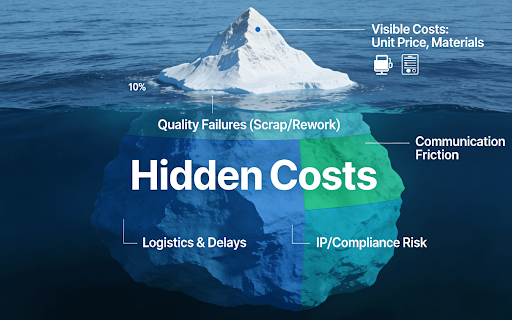
- File name Figure 2: cnc-cost-iceberg-model-infographic.jpg
- The High Cost of Compromised Quality: In fact, the highest price of compromise is probably in the domain of quality. Under these circumstances, a supplier might have given a price that is way below reality, and in order to make it good, would have compromised in many aspects such as material certificates, inspections during the processing, and overall quality control. This may result in a very high percentage of parts turning out to be non-compliant, which will incur costs for scrapping, rework, and the use of air freight for meeting the deadline. This kind of situation can also trigger other problems, such as production stoppages, missed marketing opportunities, and brand reputation damage. Yes, as per design for manufacturing guidelines, the choices made in this area have a definite influence on the costs of quality failures.
- The Impact of Inefficiency and Delays: The cost of inefficiency is real, and it affects your business financially. A supplier with outdated machinery and processes will mean longer production cycles, increasing your cost per part. More alarmingly, unreliable lead times and production planning from your supplier may mean you need to maintain higher inventory levels or, even worse, completely stop your production line. The cost of one day’s production stoppage at your factory may far exceed the cost savings from your new, lower-cost supplier. Cost analysis needs to include the reliability of your supply chain.
- Moving to a Holistic Cost Model: Thus, a meaningful financial analysis entails a deconstruction of the quote to all its constituent parts. This entails asking questions such as: Are the costs of full first article inspection reports included? What are the costs associated with any necessary engineering change orders? To take a more in-depth approach to comparing costs, a more comprehensive approach to a CNC machining cost analysis needs to be taken, which will transform a simple price sheet into a blueprint.
How to Build a Financial Evaluation Framework for Supplier Selection?
The selection of the right manufacturing partner is a capital allocation decision. An effective financial evaluation framework has to evaluate the following four interrelated factors in the selection of the right supplier: Technical Capability, Quality System Value, Operating Efficiency, and Cost Transparency. This framework enables the selection of the right supplier to become a strategic investment decision instead of a mere price negotiation. In the evaluation of the technical capability of the supplier, we want to determine whether the equipment and technical expertise of the supplier can make your part efficiently.
1. Quantifying the Value of a Certified Quality System
The second dimension measures the Quality System of the supplier as a form of Risk Insurance. A supplier with ISO 9001, IATF 16949, or AS9100D certifications is not merely “decorating the wall.” These are audited systems that demonstrate a preventive and process-oriented approach to manufacturing. A supplier with IATF 16949 certification, for example, is required to implement advanced product quality planning and statistical process controls, thereby eliminating the possibility of defect generation. The value of the system is the avoidance of costly quality failures: no recalls, no rework, and no production delays. This rigorous supplier due diligence directly impacts your bottom line.
2. Analyzing Operational Synergy and Total Cost Transparency
The last two dimensions are related to implementation and collaboration. The goal of operational efficiency is to measure the supplier’s ability in production planning, the reliability of the supply chain, and the management of logistics. If the supplier can assure the timely receipt of products and unobstructed communication, it would greatly reduce your project management costs. In this regard, cost transparency plays an important role. A superior supplier not only provides detailed and itemized quotes, but also provides value engineering options during the “Design for Manufacturability” phase. This approach is also in line with the APICS SCOR model, as it focuses on the fact that “Total Cost, Reliability, and Responsiveness are key measures for evaluating supplier value.”.
3. Implementing a Disciplined Procurement Strategy
Applying this framework of four dimensions will offer you a structured and consistent method to evaluate suppliers. Instead of the typical buyer-seller exchange “What is your best price? ” it elevates the conversation to “How do you ensure consistent quality, timely deliveries, and overall cost-efficiency for this project? ” Besides that, it opens up a forum for sharing proof of process capability, project management discipline and successful project history. This well-structured method is fundamental to a well-developed procurement strategy.
Can a “Higher Priced” Supplier Really Deliver a “Lower Cost of Ownership” to You? A Case Study in Precision Components
Where financial theory meets reality, there is a world of difference between price and cost. A detailed case study shows the real-world benefits to be had by making an investment in a premium supplier. Let’s say an automotive Tier-1 supplier in Europe needs a quantity of high-precision aluminum sensor housings. They were given two bids from qualified vendors. Supplier A had the lowest price, but had no automotive industry certifications and very generic quality documentation. Supplier B had a price that was 15% higher, but had IATF16949 and AS9100D industry certifications, very detailed process flow and SPC chart documentation, and would provide a free DFM analysis.
1. The High Cost of the “Low-Cost” Option
The team which chose Supplier A based on price alone soon discovered the severe financial consequences of such an action. The first batch of components from Supplier A was found to have a 30% defect rate owing to a lack of dimensional control and surface finish. This caused a six-week project delay, which required emergency air freight parts to be ordered, as well as a costly halt to production at the client site. This cost overrun was well over 40% of the original project budget, not even considering the intangible costs of damaged trust and operational mayhem. This “low-cost” supplier was found to be the most expensive.
2. The Value-Added Return of a Strategic Partner
The team that worked with Supplier B, however, had a completely different outcome. The supplier’s engineers proposed a design consolidation that combined three separate parts into one more manufacturable part. While the cost to machine the part was slightly higher, the elimination of assembly steps and the reduction in the BoM made sense. It also guarantees that your choice of a China CNC machining supplier rests on data and supports the anticipated financial and operational stability. After the first article inspection, the 99. 5% conformance rate was achieved and the entire order was dispatched on time. The overall project cost was 20% lower than the initial budget thanks to the elimination of delays, zero rework, and design savings. This is the ultimate proof of the fact that in precision CNC machining, investing in expertise and systemic reliability through a premium pay is most helpful to reach the lowest total cost of ownership.
3. The Financial Lesson in Partner Selection
So, the most financially savvy choice may be to select the partner that offers the least likelihood of failure, as opposed to the least expensive. The technical depth, quality systems, and collaborative engineering approach of a supplier are financial assets that reduce the likelihood of failure. They change the procurement process from a cost center to a value center by controlling costs, protecting production schedules, and even improving the design of the end product. This type of thinking is critical to the reliable manufacture of CNC parts in an uncertain global trading world.
What Are the Overlooked Financial Risks in Intellectual Property and Communication?
Intellectual Property and Ineffective Communication are two areas that are commonly overlooked but have significant financial implications. A supplier that lacks adequate Intellectual Property protection is an immediate threat to your company’s competitive advantage. If your company’s Intellectual Property is compromised, the financial consequence includes losing market share and the cost of litigation. This threat is not hypothetical; it’s an actual opportunity cost and even an existential threat to innovative organizations. So, the way a supplier handles NDA policies and data security is an important financial aspect to consider.
1. The Tangible Cost of Communication Friction
Communication inefficiency is a “silent budget killer.” Inefficiencies in the interpretation of technical drawings, response times to engineering queries, and communication of escalation procedures contribute to project timeline inflation, revision loops, and errors in the manufacturing process. This “friction cost” takes the form of engineering time, time to market, and the intangible costs of managerial angst. Working with a supplier that utilizes dedicated bilingual project engineers and effective communication systems, like a shared project portal, eliminates communication friction, ensuring correct first-time execution of specifications.
2. Proactive Mitigation as a Cost-Saving Strategy
The mitigating of these risks is a proactive approach to financial management. During the supplier evaluation, it is important to specifically ask them about their IP protection policy and to see their template agreements. How will their project management communication plan work? How often will updates be given, and what will the method be? Do they utilize digital collaboration tools for design review? Partnering with someone who is highly competent in these “soft” skills will save money and prevent costly misunderstandings, as well as protecting valuable assets. This is part of the entire process for how to evaluate a China CNC machining supplier.
3. Integrating Risk into the Total Cost Model
Thus, the comprehensive financial analysis will need to place a value on risk mitigation. The premium paid to the supplier, one whose IP protection and communication are exemplary, is a risk reduction investment. It guarantees that the outcome of your project is determined by executional excellence, not undermined by costly errors and security breaches. In the calculus of international manufacturing, these are not peripheral considerations; they are integral to the total cost and total value equation.
What Practical Steps Can You Take Next Week to Improve Your Sourcing Strategy?
It is essential to understand that making a change from a reactive to a more strategic sourcing approach requires immediate and practical actions. The first step is to apply the four-dimensional approach to your current and potential sourcing partners. The first step is to do a retrospective total cost of ownership analysis on a recently completed project. This involves not only the actual cost of the project but also all the additional costs incurred during the process, such as quality checks, travel for audits, and labor for managing the project internally.
1. Implementing Evidence-Based Supplier Requests
You should redesign your request for quotation template to require evidence rather than promises. You should seek proof of process capability (Cp/Cpk) for critical dimensions on their closest similar parts from their past production when you send your next RFQ. Go beyond just their change order policy and costs by also asking them about their production scheduling software, and their main performance indicators for on-time delivery. This is a game-changer and is the beginning of a sophisticated procurement strategy.
2. Building a Strategic Partnership for Continuous Improvement
Lastly, think of your best supplier as a long-term partner in optimizing costs. Involve them from the start of the design process to analyze DFM. Also, use the quality of feedback from your supplier as a criterion in a supplier scorecard. Talk about long-term agreements that provide price stability in return for commitment to volume. Make sure, however, that such agreements are complemented by provisions for continuous improvement. What you want to achieve here is a partnership where your supplier works with you to minimize costs, not just compete on price as price continues to erode.
3. Committing to a Value-Driven Sourcing Culture
Therefore, working on your sourcing strategy may lead to an improved organization. It is a commitment that requires all three departments: finance, engineering, and purchasing, to totally embrace total cost of ownership philosophy. By doing these three things – retrospective analysis, evidence-based vetting, and partnership building – you institutionalize a more intelligent, financially disciplined approach to global sourcing. You turn a tactical discipline of price negotiations into a strategic discipline of sustainable cost reduction, risk management, and value creation, where every sourcing decision is a net positive contributor to your company’s financial well-being.
Conclusion
Sourcing custom online CNC machining service is a fundamental strategic financial decision rather than a procurement transaction. Therefore, using a holistic evaluation system based on a total cost of ownership approach that includes aspects such as technical competency, quality system value, business efficiency, and risk mitigation allows finance leaders to transform the way in which sourcing operates in an organization. This approach goes beyond the simplistic initial price quote and allows organizations to partner with companies that provide true value in the long term and deliver cost optimization as a sustainable business solution in a complex global marketplace.
FAQs
Q: Is it necessarily cheaper to work with CNC Machining suppliers in China, given all these hidden costs?
A: Not necessarily. While it is true that China is known to be one of the more cost-effective suppliers, one should not forget that the real cost savings are realized when working with a capable and systematized supplier. A low-cost quote may not necessarily translate to actual cost savings, given the quality failures and communication costs that may arise.
Q: How can I accurately quantify the “risk” of quality issues with one supplier over another?
A: Make this quantifiable by assessing real process controls. Request supplier’s data on their capability for various dimensions, and check their first article inspection and SPC processes. Ideally, suppliers should be IATF 16949 certified, indicating a quality system is in place. The money side is the possible cost of a batch of parts failing. This is a risk if a supplier isnt capable. If a supplier has a high level of capability, this risk is lower in terms of potential cost exposure.
Q: What is the most important document to obtain from a potential CNC machining supplier in China?
A: After getting a quote, I think the most important document to obtain from a potential supplier is a detailed PFMEA for your part or parts. A legitimate supplier should be able to walk you through a detailed explanation of a PFMEA, which is a critical aspect of their operations and demonstrates their level of understanding of how to make your parts correctly, which is a key aspect of both price and delivery.
Q: What is the significance of payment terms with a Chinese supplier in relation to the financial analysis?
A: Payment terms with a Chinese supplier directly impact your cash flow and your cost of capital. Normal payment terms of 30/70, where you pay 30 percent up front and 70 percent upon delivery, ties up your capital. Better payment terms, such as net 30, improve your cash position, but there is a price to pay for this benefit, which should be analyzed in your overall analysis. Using Letters of Credit for larger orders is also a good risk management tool.
Q: Could the location of the supplier in China affect the cost and reliability?
A: Yes, to a significant extent. A supplier in one of the major industrial clusters will have access to a more developed network of sub-suppliers, hence faster lead times and possibly lower logistics costs. They will also have more experience in handling exports. While their operating costs might be higher, the supply chain robustness and efficiency of a well-developed industrial cluster might lower the total cost and increase their reliability.
Author Bio
This article is based upon the financial and operational expertise of international manufacturing specialists with a proven track record in the de-risking and optimization of global supply chains worldwide. For finance and procurement professionals looking to move beyond price comparisons and leverage a strategically relevant and cost-optimized global supply chain, a review of the partnership is the next logical step forward. LS Manufacturing is an international manufacturing partner that is certified with a high level of technical expertise and quality systems that are both IATF 16949 and AS9100D certified, providing a predictable cost result for clients around the world and turning overseas procurement into a competitive advantage.