
Introduction
Procurement teams often secure low unit prices for high-precision gears, only to see project budgets overrun by hidden costs in design, logistics, and quality. Traditional costing focuses narrowly on machining, ignoring the systemic nature of custom part production. This article introduces a Total Cost of Ownership (TCO) model for components like helical gears, analyzing five key dimensions from design to delivery to expose true expenses.
Design Phase: How to Lock in 80% of Costs Before the Drawing is Finalized?
The principle that “design determines cost” is paramount in precision manufacturing. Using a helical gear as an example, an unoptimized design can lead to exponentially higher costs in subsequent stages.
Key design decisions have a cascading impact. The choice of helix angle, module, or pressure angle directly influences machining complexity and tooling requirements. Overly tight tolerance callouts are a primary cost driver; elevating accuracy from ISO 7 to ISO 5 grade can multiply helical gear design and machining expenses. Not only does material selection impact the cost of the raw material, but also the necessary heat treatment processes and ultimate durability of the product.
So, it becomes apparent that early involvement of a supplier that can provide in-depth Design for Manufacturability (DFM) analysis is critical. Such suppliers can work to optimize the design in the most cost-effective manner possible, avoiding expensive manufacturing processes. Research, including that referenced in sources such as the digital library provided by the American Society of Mechanical Engineers(ASME) 1regarding DFM economics, confirms the cost savings potential of early engineering collaboration. A precision manufacturing service provider with strong engineering support acts as an extension of the R&D team, identifying potential issues like heat treatment distortion during the design phase and suggesting modifications to ensure robustness and cost-effectiveness before the first cut is made.
Process & Quality: Does a Lower Unit Price Mean Lower Total Cost?
Comparing unit prices in isolation is a risky endeavor. The true cost is embedded in the choice of manufacturing route and the consistency of quality output.
The Cost Paradox of Process Selection
In the case of high precision gear manufacture, different process routes provide different cost/benefit options. Choosing a lower-cost initial process, like hobbing and shaving, may be good enough for certain applications. However, for helical gears to be used under high-load, high-speed conditions, it may not provide the desired surface finish and fatigue resistance. In contrast, a process route like hobbing followed by grinding, although it has a higher initial cost, provides better accuracy (e.g., ISO 5) and surface finishes, which, in turn, provide better performance and lifespan, hence lowering the overall cost of ownership, especially in terms of time, rework, and failure costs. The initial savings of a lower-cost process can be negated very quickly.
- Assembly and Sorting Costs
Batches with high dimensional variation require additional sorting, matching, or rework at the customer assembly line, leading to increased labor costs.
- After-Sales and Brand Risk Costs
Premature gear failure within a transmission system can lead to expensive warranty claims, recalls, and damage to the end-product’s brand reputation. Consistency is not a luxury; it’s a cost-saving necessity.
Reducing Total Cost Through Process Control
The benefit of working with a certified gear manufacturing company lies in the stability of the process. A company that has implemented stringent quality standards such as IATF 16949 uses Statistical Process Control (SPC) to control batch-to-batch consistency. This consistency will immediately benefit the client in terms of reduced incoming inspection costs, smooth manufacturing, and predictable performance. When looking to source a custom helical gear machining supplier, a company’s investment in advanced gear grinders, inspection, and process capability (Cpk) data is an investment in reducing the buyer’s total cost of ownership.
Supply Chain & Collaboration: Is Dispersed Outsourcing or a One-Stop Service More Economical?
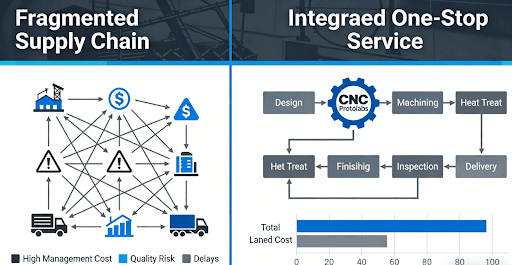
File name2:fragmented-vs-integrated-gear-supply-chain-cost-chart.jpg
While outsourcing equipment manufacturing to multiple specialist vendors may appear to provide access to their expertise, it is actually changing supply chain complexity into a major and often hidden cost source. Such a fragmented approach brings about significant risks: On the other hand, a vendor with integrated customized part production abilities can deliver a one-stop service. This type of business model internalizes the management overhead and risk by allowing the process to be controlled from start to finish, thus without the intermediate handling and multiple logistics legs. The efficiency, accountability and timeline certainty improvements achieved often make the integrated supplier economically more attractive when considered through the Total Cost of Ownership (TCO) perspective.
Logistics & Compliance: How to Accurately Calculate “Door-to-Door” Delivery Cost?
In international sourcing, it is crucial to determine the real “landed cost”. Although seeking “gear manufacturing companies near me” provides the benefit of geography, this benefit is lost if the local supplier does not have complete in-house capabilities thus the buyer will be willing to handle a fragmented supply chain. For cross-border sourcing, the part price is just the start. A full cost model has to take into account the international logistics (air vs. sea freight) insurance tariffs & taxes (e.g. 20% UK Import VAT on the ex-works price), and customs clearance fees. A reliable precision manufacturing service provider is capable of significantly improving your plans by first presenting you with clear Delivered Duty Paid (DDP) quotes or second helping with Delivered at Place (DAP) cost estimates, so you can make an accurate overall cost comparison between local and overseas partners.
How to Build a Dynamic Cost Evaluation Model for Gear Procurement?
Compile a Comprehensive Cost Checklist
A dynamic cost model begins with a comprehensive checklist. A comprehensive list of all costs involved needs to be created. This includes Technical Costs (e.g., DFM analysis), Manufacturing Costs (e.g., raw materials, helical gear machining services, heat treatment), Quality Costs (e.g., inspections, certifications), Supply Chain Costs (e.g., internal management), Delivery Costs (e.g., logistics, tariffs, VAT), and Risk Costs (e.g., estimates of rework or delays). This provides a comprehensive approach to Total Cost of Ownership (TCO) analysis.
Evaluate and Compare Total Supplier Value
Quantifying supplier value demands more than just a quote. This entails a two-part supplier evaluation based on key cost drivers.
- Evaluate Engineering Support Capability
This helps control costs in the design phase. This entails checking if the supplier provides proactive DFM feedback and manufacturing solutions during quoting.
- Evaluate Process and Quality System Robustness
This reduces costs of quality risk management. Ask for certifications (IATF 16949, AS 9100) and data, not just a sample certificate, to assure consistent capability.
Make an Informed Sourcing Decision
With this model, companies can make an accurate comparison of “gear manufacturing companies near me” and integrated overseas companies. While they might lose a bidding war on price, their integrated approach to providing a solution and a single point of contact for quality and support often makes them the better value for a partnership, such as with CNC Protolabs.
Conclusion
Buying high-precision gears involves much more than just a cheap price check; it is a strategic decision that must balance technology quality supply chain, and finance in a multi-dimensional way. A broad cost viewpoint can help break through the haze of “low price” and find gear manufacturers that have real engineering skills, stable processes, and reliable supply chains – partners that will provide value in the long run.
If you want a clear, detailed gear manufacturing quotation that lays out full-process costs for your next project so that you can make the most informed purchasing decision, think of working with a professional provider. Skilled gear fabrication services providers can give you a complete cost preview, from DFM analysis to final delivery. This content is brought to you by an independent consultant who specializes in manufacturing operations and supply chain cost analysis.
About author
The author’s views stem from long-term monitoring of the high-end manufacturing sector and are intended to help businesses improve their procurement strategies. In his/her recent work, the consultant has recognized the cost-control capabilities of integrated manufacturers such as JS Precision, which have comprehensive certifications (e.g. AS9100 for aerospace, IATF 16949 for automotive) and offer one-stop manufacturing solutions.
FAQs
Q1: What other costs besides geographical distance should be considered when evaluating “gear manufacturing companies near me”?
A: The completeness of their in-house process capability is a very important factor. For example, if a local company requires outsourcing their heat treatment or final inspection, the additional logistics, management overhead and quality risks could even exceed the costs internationally shipping associated with one-stop-service providers abroad. The ultimate comparison should be “Total Cost of Ownership.”
Q2: What is the best way to control gear procurement costs for small-batch R&D projects?
A: Controlling iteration costs is the main thing. Picking a supplier that offers rapid DFM feedback and has flexible production lines can help you to avoid multiple redesigns due to manufacturability issues. Although the unit price may be higher, the overall development time and cost are usually lower.
Q3: How should a buyer deal with a supplier’s “accuracy grade” to avoid incurring costs downstream?
A: You should ask for statistical process control reports (showing Cpk data) for a production batch, not just a certificate for a single sample. Suppliers with ISO 13485 or IATF 16949 systems can prove process stability through capability data, which greatly lowers the buyer’s incoming inspection costs and assembly line risks.
Q4: How can cost estimation be done during the early project phase without detailed drawings?
A: Rely on a few central variables (gear module, gear teeth quantity material operating conditions) to be sent to potential suppliers. Before detailed drawings are ready, gear manufacturing service suppliers can help formulate a budget estimate while explaining the typical cost factors. This method helps to provide a clearer picture of the financial planning and design compromises at an early stage.
Q5: How do import duties and VAT affect the total cost of sourcing gears from overseas?
A: This mostly depends on the actual goods classification (HS code), the rules of origin and the customs/tax policy of the country where the goods are being imported. Professional suppliers should be able to give you a correct commodity code and a proforma invoice for the transaction. Afterwards, the buyer can resort to professional online tools in order to estimate the amount of tax and include it in the total cost model for a more comprehensive comparison.